Beyond the Boundary: visit our online exhibition

Beyond the Boundary: visit our online exhibition

Explore a digitised version of the 2025 Beyond the Boundary travelling exhibition and discover how history, art, and environmentalism combine to teach us about invasive plants

Have you heard of invasive species?

Invasive species are defined as a non-native species that causes harm to its new environment. They have the ability to spread, and effect biodiversity, our economy, human health, and the way we live.

The majority of ornamental plants we find in in our gardens are non-native but are not causing problems. However, some of the plants in our gardens are invasive and can cause harm to the wider environment.

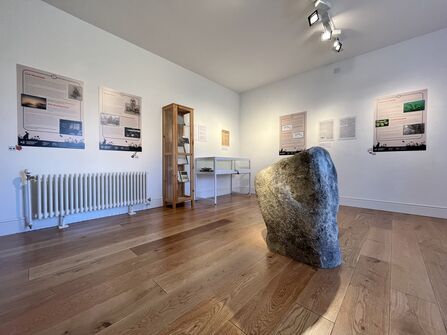
In 2025, the Garden Escapers project hosted an exhibition in three places across North Wales: Storiel in Bangor, the visitor centre on the Great Orme in Llandudno and Oriel Plas Glyn y Weddw in Llanbedrog. These regions focused on the key project areas for investigating and preventing invasive species.

Beyond the Boundary at Plas Glyn y Weddw

Beyond the Boundary at Oriel Plas Glyn y Weddw © NWWT

The panels below explore the story of how some invasive plants came to the UK in Wardian cases during the 19th century and how some of these plants adapted a little too well to their new environment.

Click through the boards below to read more about the exhibition.

The story follows some of these plants and their impacts on the modern world, as well as the impacts of climate change. The story finishes by exploring what we can do to help minimise the impacts of invasive plants on our wider environment.

Click here for a PDF plain text version of the panel text

Discover more in the film below, including interviews with nature reserve officer Luke Jones, and artist Manon Awst.

Beyond the Boundary also showcased a number of artefacts. They helped to tell the story of the history of invasive plants in the UK and highlighted their connections with people. Some can be seen here.

Wardian case

Wardian case © NWWT

Wardian case replica

This replica of a Wardian case is inspired by designs in an article in the The National Magazine (1857). This style of Wardian case was used for sea voyages and differs to the ornamental Wardian cases often found in homes. Not to scale.

Letter from Charles Mallard

Letter © AJCP

Letter from Charles Mallard

In 1833, Ward sought to test his Wardian case by sending live plants by ship from the UK to Sydney in Australia. In this letter, the ship’s captain describes the mission as having “fully succeeded” after their eight-month journey.

On the Growth of Plants in Closely Glazed Cases

On the Growth of Plants in Closely Glazed Cases © Cambridge University Press

On the growth of plants in closely gazes cases

In this book (1842), Nathanial Bagshaw Ward explores the common causes of plant death and the benefits of protecting them from harsh conditions with his Wardian case. His work had far-reaching effects allowing for the safe movement of tea from China, rubber from the Amazon, and more.

A Primrose from England

A Primrose from England © Edward Hopley

A Primrose from England

Created by Edward Hopley in 1855, this image depicts crowds of people gathered around a potted flowering primrose. The scene followed the arrival of the primrose in Australia by way of a Wardian Case to a sensational reception – it’s even said it needed to be protected by guard! 

Flower press

Flower press © Lisa Toth

Flower press

The Victorians loved flowers. Flower pressing was a popular past-time during the Victorian period. Plants were usually picked in the late afternoon, after the dew had tried. They were then placed between blotting paper, and pressed tight to preserve the plant which could be used for anything from bookmarks to clothing accessories. 

C. simonsii herbarium specimen

C. simonsii herbarium specimen © Bangor University Herbarium

Herbarium specimens - contoneaster

Cotoneasters are popular garden plants, but some are now considered invasive species because of their detrimental impacts on nature. One example - shown here - is Himalayan cotoneaster (Cotoneaster simonsii) which was introduced in 1865 but is now covered by legislation. This was originally labelled as Cotoneaster vulgaris and collected from the Great Orme in Llandudno.


Art and environmentalism

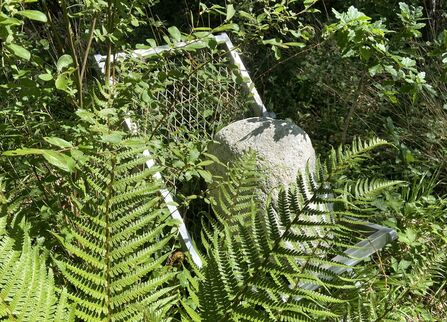
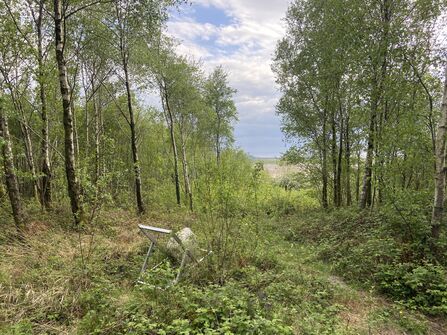
The centrepiece of our exhibition was a sculpture created by Welsh artist Manon Awst. Awst has exhibited widely in the UK and Germany and her works have been part of the National Library of Wales, UK Government and Welsh Parliament Collection.

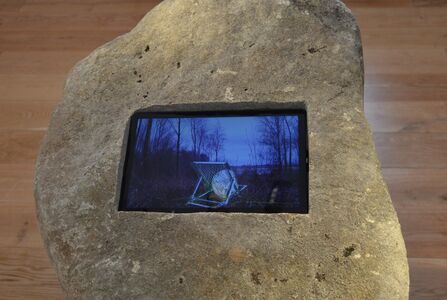
Her artwork, known as Tu Hwnt I’r Ffin, explores the porous boundaries between gardens and wider, wilder habitats. It consisted of two companion pieces – one located in the exhibition space and the other sitting on Gwaith Powdwr Nature Reserve in Penrhyndeudraeth. 

Tu Hwnt i'r Ffin explores the porous boundaries between human and wider, wilder habitats. It is open to interpretation but hopes to inspire thought about the impact that people can have on the environment and consider the effects of invasive plants that break beyond the boundaries of our gardens.

It made me think of how we often treat our natural habitat badly by dumping things in it. Yet, it makes me think about how nature will always heal things in the end, even if we disappear.
Anon.

Tu Hwnt i'r Ffin timelapse © Manon Awst

What can you do to help?

The effects of invasive species mean it's illegal to grow certain plants or allow them to spread beyond the boundaries of gardens. However, not all invasive species are covered under legislation. It's important that we all take responsibility to protect nature and people.

Check out our new Gardeners' Toolkit for information, tips and tricks for managing invasive plants in your garden, including advice about alternative plants. 

Includes plant profiles, a video series, advice about legislation and a printable calendar to help you manage invasive plants.